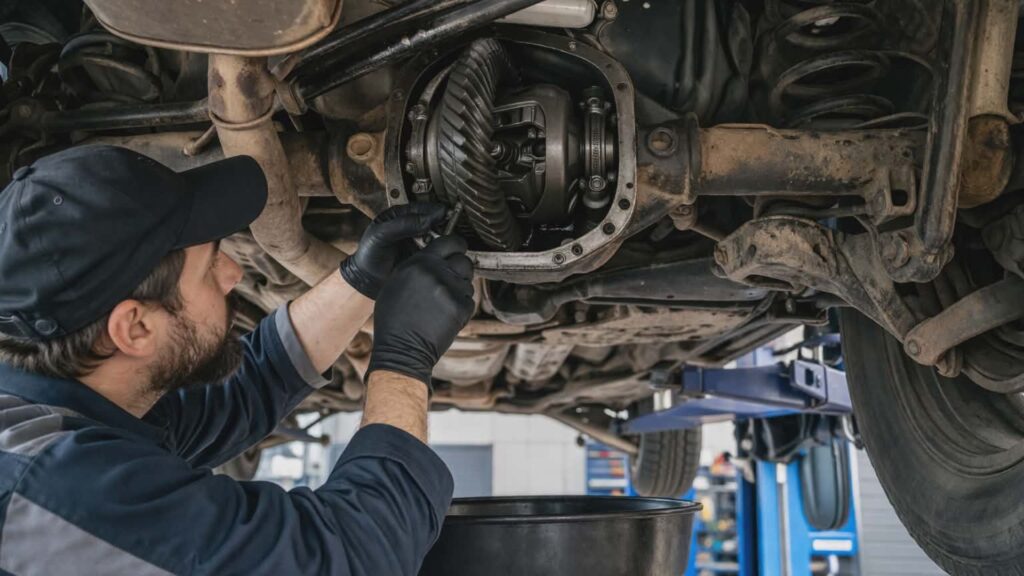
Differential Grinding Noise: Causes, Fixes, and When to *Actually* Worry
That grinding noise coming from under your vehicle is hard to ignore. It can start as a faint hum, grow into a noticeable growl, and eventually become a sound that makes every trip feel like a gamble. If the noise seems to be coming from the middle or rear of your vehicle, your differential could be the source of the problem.
Understanding what the differential does, why it makes noise, and what to do about it can save you from a costly breakdown down the road. This guide breaks it all down in plain language.
What Does the Differential Actually Do?
The differential is a set of gears that allows your wheels to spin at different speeds. This matters most when you turn a corner: the outer wheels need to travel farther than the inner wheels, so they have to spin faster. The differential makes that possible without causing your tires to drag, skip, or fight each other.
Most rear-wheel-drive vehicles have a differential at the back axle. All-wheel-drive and four-wheel-drive vehicles typically have one at both axles, and sometimes a center differential as well. Front-wheel-drive vehicles use what is called a transaxle, which combines the transmission and differential functions into a single unit.
When the differential is working correctly, you probably never think about it. When it starts to fail, you notice it fast.
What Does a Differential Grinding Noise Sound Like?
Differential noises can vary, but a grinding noise typically sounds like metal rubbing or scraping against other metal. You might also notice it described as a rumble, a howl, or a whine, depending on the stage of wear.
Some drivers notice the noise only at certain speeds. Others hear it constantly. In some cases, the grinding only shows up during turns, which is a strong indicator that the differential is involved rather than another component.
Here are some common sound patterns to pay attention to:
- Grinding during turns often points to worn spider gears inside the differential
- Constant grinding or rumbling – may indicate worn bearings
- Whining that changes with speed – often linked to ring and pinion gear wear
- Clunking when accelerating or decelerating – could suggest gear backlash or worn U-joints
These patterns are not universal, and many drivetrain components can mimic differential sounds. That is why a proper diagnosis matters more than guessing.
Common Causes of a Differential Grinding Noise
Low or Contaminated Differential Fluid
This is the most common cause of differential noise, and it is also the most preventable.
Differential fluid lubricates all the gears and bearings inside the housing. When the fluid level drops due to a leak or when the fluid breaks down over time, metal parts start grinding against each other without adequate protection.
Differential fluid does not last forever. Over time, it becomes thick, dark, and less effective. If it has never been changed on your vehicle, there is a good chance it is due or overdue.
Worn Bearings
Bearings support the rotating shafts inside the differential. When they wear out, you typically hear a rumbling or grinding noise that may change in pitch or volume as your speed changes.
Bearing failure can happen gradually, but once it starts, it usually gets worse quickly.
Driving on worn bearings puts stress on everything around them, including the ring and pinion gears. What starts as a bearing problem can turn into a much larger repair if it is not addressed early.
Ring and Pinion Gear Wear
The ring and pinion gears are the primary gears inside the differential. They transfer power from the driveshaft to the axles. These gears are precision components, and when they wear unevenly or sustain damage, they produce a whining or grinding sound.
Ring and pinion wear is sometimes caused by poor lubrication, but it can also result from aggressive driving habits, off-road use, or towing loads beyond the vehicle’s rated capacity.
Worn or Damaged Spider Gears
Spider gears are the small gears inside the differential that allow each wheel to rotate at a different speed. When they wear out, you may notice grinding or clunking, specifically when making turns. This happens because the spider gears are under the most stress during cornering.
Spider gear damage is more common in vehicles that have been used for towing or have experienced repeated hard acceleration.
Damaged U-Joints or CV Joints
While not technically part of the differential itself, worn universal joints (U-joints) or constant velocity joints (CV joints) can produce grinding and clunking sounds that feel like they are coming from the differential. These joints connect the driveshaft to the differential or axle, and they wear out with mileage and use.
If your vehicle’s grinding noise gets worse during acceleration or comes with vibration, the joints are worth inspecting along with the differential.
Is It the Differential or Something Else?
Differential grinding noises are easy to confuse with other drivetrain and suspension problems. Here is a quick breakdown of what else could be causing the noise:
Wheel bearings produce a rumbling or humming noise that often changes when you shift your weight side to side while driving. The sound typically comes from one side of the vehicle rather than the center.
Brake issues can cause grinding that feels similar, but brake-related grinding is usually more prominent when you apply the brakes rather than during freeroll.
Transmission problems sometimes produce grinding or whining sounds, especially during acceleration or gear changes. If you suspect this, it is worth having the transmission inspected to rule out transmission-related causes before focusing on the differential.
CV axle wear can also create grinding and clunking, especially during sharp turns at low speeds, which can feel similar to a differential issue in front-wheel-drive vehicles.
The safest approach is to have the vehicle inspected by a technician who can trace the noise to its actual source.
How Serious Is a Differential Grinding Noise?
The short answer: it depends on how long you wait to address it.
A small fluid leak caught early is a minor fix. Ignoring that same leak for months while the gears grind dry is a completely different story. Differential repairs can range from a fluid change to a full rebuild or replacement, and the difference in cost often comes down to how quickly the problem was addressed.
Here is a general sense of how urgency scales with the symptom:
- Mild whining or humming with no other symptoms – monitor closely, schedule an inspection soon
- Grinding that appears during turns – schedule service promptly, avoid aggressive driving
- Constant grinding with vibration or pulling – do not delay, drive as little as possible until inspected
- Clunking or sudden loss of power to the wheels – stop driving and get the vehicle towed
Driving on a failing differential does not just risk further damage to the differential itself. It can affect the axles, driveshaft, and even lead to loss of vehicle control in severe cases.
How to Fix a Differential Grinding Noise
Start With a Fluid Check and Change
If the noise is relatively new and not severe, the first step is checking the differential fluid. Low fluid or fluid that has broken down can be the entire cause of the noise. A fluid drain and refill with the correct gear oil is the least expensive fix possible.
Routine preventative maintenance services that include differential fluid changes are one of the simplest ways to avoid this kind of problem from developing in the first place.
Bearing Replacement
If worn bearings are confirmed as the cause, they need to be replaced. This is not a job for a driveway mechanic in most cases. Bearing replacement inside a differential requires proper tools, careful setup, and often precise adjustments to gear clearances after the bearing is installed.
Doing it wrong can cause the gears to mesh incorrectly, which leads to noise and accelerated wear even after a fresh repair.
Ring and Pinion Replacement
This is one of the more involved differential repairs. The ring and pinion gears must be matched to each other and set up with exact tolerances. Done correctly, a new ring and pinion set will be quiet and long-lasting. Done incorrectly, you will be back in the shop with the same noise.
This type of work benefits from professional driveline repair services where technicians have the tools and experience to set up the gears correctly the first time.
Full Differential Rebuild or Replacement
In some cases, especially when multiple components are damaged, a full differential rebuild or replacement makes more economic sense than replacing individual parts one at a time. A rebuilt differential using quality components can restore your vehicle’s performance and extend its life significantly.
Your technician can help you decide whether a rebuild or a replacement unit is the better option based on the vehicle’s age, mileage, and condition.
Preventing Differential Problems Before They Start
The best differential repair is the one you never need. Most differential problems are the direct result of one thing: neglected fluid changes.
Most manufacturers recommend changing differential fluid every 30,000 to 60,000 miles, though the interval varies by vehicle type and use. If you frequently tow, drive on rough roads, or use four-wheel drive regularly, you may need to change the fluid more often.
Beyond fluid changes, having your vehicle’s comprehensive auto repair services include a drivetrain inspection periodically can catch issues like small leaks, worn seals, or early bearing wear before they become expensive problems.
It is also worth paying attention to changes in how your vehicle drives. If you notice vibration, pulling to one side, or unusual sounds – especially if they are new or getting worse – do not wait.
These symptoms often signal something that gets worse with time and mileage. For context, vibration while driving can sometimes point to more than one issue at once, which is covered in more detail in this article on common reasons your car is shaking at high speeds.
How a Technician Diagnoses Differential Noise
A proper diagnosis starts with a test drive. An experienced technician will listen to the noise while the vehicle is moving, paying attention to when it occurs, during acceleration, deceleration, cornering, or constant speed. They will also note which part of the vehicle the noise seems to come from.
After the test drive, the inspection typically includes checking the differential fluid level and condition, looking for leaks around the differential housing and axle seals, and sometimes listening with an electronic stethoscope to isolate the source. If needed, the differential may be partially disassembled to inspect the gears and bearings directly.
This kind of thorough inspection is what separates a real repair from a guess.
Frequently Asked Questions About Differential Grinding Noise
Can I drive with a grinding differential?
Technically, yes, but it is not a good idea. Driving with a failing differential accelerates wear on the internal components and can lead to complete failure. In worst-case scenarios, a failed differential can lock up a drive axle while the vehicle is in motion, which is a serious safety hazard.
How much does a differential repair cost?
Costs vary significantly based on the type of repair. A fluid change is relatively inexpensive. Bearing replacement, ring and pinion work, or a full rebuild will cost more, with prices depending on the vehicle make, model, and labor involved. Getting an accurate estimate before work begins is the best way to understand what you are facing.
How do I know if it is the differential and not the transmission?
Transmission grinding typically happens during gear changes or acceleration and is felt through the shifter or pedal. Differential noise tends to be more constant and related to vehicle speed or wheel rotation rather than gear selection. A technician can usually distinguish between the two with a test drive and inspection.
How long does a differential last?
A well-maintained differential can last the life of the vehicle. Neglected differentials – particularly those that run low on fluid or go without regular fluid changes – can fail well before 100,000 miles. Proper maintenance is the key variable.
Does a differential grinding noise always mean a big repair?
Not always. If the noise is caused by fluid breakdown or a low fluid level, a fluid change might resolve it entirely. However, if the gears or bearings have already sustained damage, more involved repairs will be necessary. Early action keeps the cost down.
Conclusion
A differential grinding noise is your vehicle telling you something is wrong. The longer it goes unaddressed, the more expensive and serious the repair tends to become. Whether it turns out to be a simple fluid change or a more involved bearing or gear repair, the first step is always getting an accurate diagnosis.
If you are hearing unusual sounds from under your vehicle and you are near Covington, IN, contact Newnum and Sons Garage at 765-793-3334. Their team will identify the problem and explain your options clearly before any work begins.