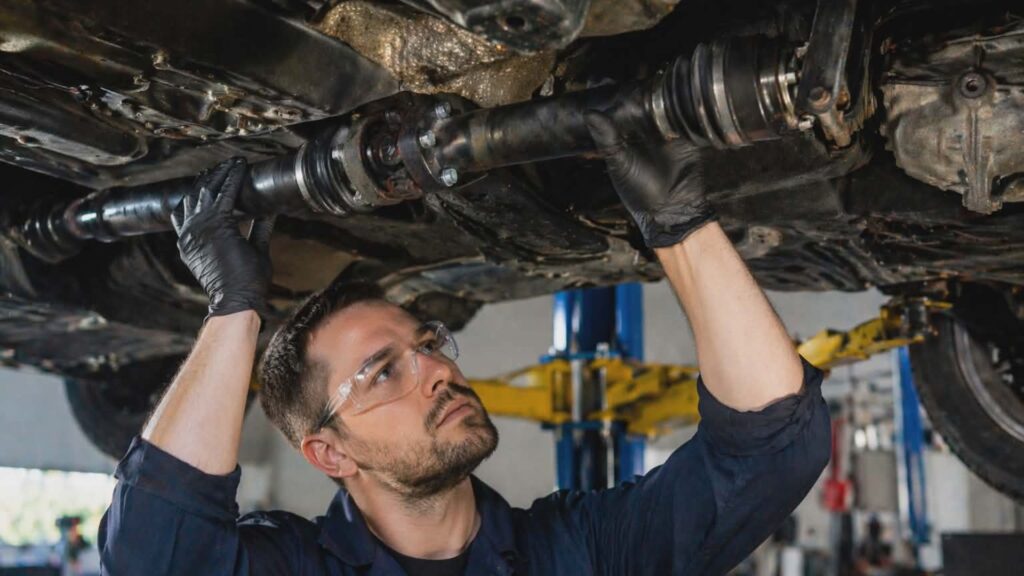
What Causes Driveshaft Vibration and How to Fix It Fast
You’re cruising down the highway, and suddenly your floorboard starts buzzing, your seat shakes, and something just feels off. That unsettling rumble is often driveshaft vibration, and it’s one of those problems that tends to get worse, not better, if you ignore it.
The good news is that once you understand what’s causing it, the fix is usually straightforward.
Let’s break it down.
What Is a Driveshaft and What Does It Do?
The driveshaft is the rotating tube that transfers power from your transmission to your differential, which then sends that power to your wheels. In rear-wheel-drive cars and trucks, it’s a critical link in the drivetrain. In four-wheel-drive vehicles, a transfer case splits power between the front and rear axles using multiple driveshafts.
When the driveshaft is installed correctly and everything is balanced, you won’t feel a thing. When something goes wrong, your vehicle will let you know.
Common Causes of Driveshaft Vibration
Worn or Failing U-Joints
The universal joint, also called a u-joint or cardan joint, connects the drive shaft to the transmission output shaft and the differential yoke. These joints allow the shaft to move up and down with your rear suspension while still spinning smoothly.
When a u-joint wears out, it develops play in the yoke ears. This causes the driveshaft to wobble as it spins, producing a vibration that pulses twice per revolution of the shaft. You might also hear a clunking noise during acceleration or deceleration. Replacing worn u joints is one of the most common driveline repairs a shop will perform.
Missing or Broken Balance Weights
Driveshafts are precision-balanced from the factory using small weights welded to the driveshaft tube. If one of those balance weights falls off, or if broken tack welds allow a weight to shift, the shaft becomes uneven. Think of it like a tire that’s out of balance. The heavier side rotates faster through its arc, and the whole assembly starts to vibrate.
This type of vibration is often called transverse vibration, and it typically gets worse as speed increases. A shop can rebalance the shaft by attaching new weights to the correct position along the rotating centerline.
Damaged or Dented Shaft Tube
Even a small dent in the middle of the tube can throw off the driveshaft’s balance and cause vibrations you’ll feel through the floor. Road debris, a curb strike, or damage to the driveshaft from bottoming out can all do this. Sometimes the damage is obvious; other times it takes a close inspection to spot a kink or deformation.
If there’s significant damage to the shaft, replacement is usually the safest call. A bent or dented tube can fail due to critical speed issues, where vibration causes the driveshaft to flex uncontrollably at high rotational velocity.
Worn Slip Yoke or Slip Joint
The slip yoke or slip joint allows the driveshaft to change length slightly as your suspension moves. Over time, the slip splines inside this joint wear down. When that happens, the driveshaft can develop a wobble or kink at the transmission end. This often shows up as a vibration that appears during light throttle or when you shift into overdrive.
Misaligned Driveline Angles
Every driveshaft operates at an angle. There are correct driveline angles designed to keep the velocity of rotation consistent from one end to the other. When those angles are wrong, usually because of a suspension lift, a collapsed mount, or rear-end sag, the joints and the driveshaft experience uneven torque loads.
Misaligned angles are particularly tricky because the vibration caused can mimic other problems. Shops use special tools to measure the operating angle at each end of the shaft and bring them back into phase with each other.
If you’ve recently had suspension or rear suspension work done and now feel a buzz, this could be the culprit. It’s also worth reading more about the causes of car shaking at high speeds to rule out other contributing factors.
CV Joint Wear
Some vehicles use a constant velocity (CV) joint instead of a traditional U-joint setup. These joints keep rotating smoothly across a wider range of angles, but they wear out too. A failing CV joint often produces a vibration that changes under load or during turns.
How to Diagnose Drive Shaft Vibrations
Most shops start by test-driving the vehicle and noting exactly when the vibration problems appear. Does it happen at 60 mph? Only under acceleration? Does it go away at certain speeds?
From there, a technician will inspect the driveshaft visually, check for play in every u-joint and flange connection, look for missing balance weights, and measure driveline angles. Advanced vehicle computer diagnostics can also help identify whether something loose in another system is causing the vibration rather than the shaft itself.
If the driveshaft is rotating correctly but vibration persists, they may also check the pinion yoke, the differential, or even the transmission for related issues. Professional transmission repair can sometimes resolve vibrations mistakenly blamed on the driveshaft.
When Should You Get It Checked?
If you notice a vibration that gets worse with speed, clunking during gear changes, or a shudder during acceleration, don’t wait. A driveshaft spinning out of balance puts stress on every connected component. Poor driveline angles can accelerate wear on u-joints, axle seals, and even your brakes. Check out the available suspension and brake repair options if you suspect related wear.
You can also explore the full range of driveline repair services to understand what a complete inspection covers.
Conclusion
Driveshaft vibration is not something to push through or ignore. Whether it’s a worn universal joint, missing balance weights, a damaged shaft tube, or misaligned driveline angles, each cause has a clear solution when caught early.
The team at Newnum and Sons Garage in Covington, IN, is ready to diagnose the problem honestly and get your vehicle back to running smoothly. Call 765-793-3334 or visit newnumsgarage.com to schedule your inspection today.