7 Signs of Car Water Pump Failure You Shouldn't Ignore
Your car’s water pump is one of those parts that quietly does its job until the day it doesn’t. And when it stops working, the consequences hit fast. We’re talking overheating, blown gaskets, and in the worst cases, a seized engine block that costs more to fix than the car is worth.
The good news? Your vehicle almost always gives you warning signs before things go that far. You just have to know what to look for.
What Does the Water Pump Actually Do?
The water pump is the heart of your internal combustion engine cooling system. Its job is simple but critical: it keeps coolant circulating between the engine and the radiator so your engine stays at the right temperature.
When coolant flows properly, heat gets transferred away from the engine block and expelled through the radiator. When the pump fails, that flow stops, and heat builds up fast. Your engine wasn’t designed to handle that kind of punishment.
Signs of Car Water Pump Failure You Should Never Ignore
1. Coolant Leaks Under Your Car
One of the earliest signs of car water pump failure is a puddle of coolant forming underneath the front of your vehicle. Coolant is usually green, orange, or pink, and it has a slightly sweet smell that’s hard to miss.
The water pump uses gaskets and seals to keep coolant contained under pressure. As wear and tear adds up over time, those seals degrade and allow coolant to escape. If you notice a puddle that keeps coming back, don’t write it off as nothing.
2. Whining or Grinding Noise Near the Engine
A failing water pump often announces itself with noise. If you hear a high-pitched whining or a low grinding sound coming from the front of the engine, that’s a red flag worth taking seriously.
The culprit is usually a worn bearing inside the pump or a damaged pulley that’s no longer spinning correctly. As the bearing deteriorates, it creates friction and vibration that produces that unmistakable noise. This is a mechanical problem that won’t fix itself, and it tends to get worse quickly.
3. Engine Overheating
This one should send you straight to a mechanic. If your temperature gauge is climbing toward the red zone or you’re seeing warning lights on the dashboard, your cooling system may already be struggling.
Without a functioning pump, coolant can’t do its job. The engine block absorbs heat with nowhere for it to go. Driving on an overheating engine, even for a short time, can warp cylinder heads or destroy gaskets in ways that make a simple pump replacement look cheap by comparison.
4. Steam or Smoke Coming From Under the Hood
Steam rising from under the hood is not just an annoyance. It’s a sign that coolant is either leaking onto hot engine components or that your engine has already crossed into dangerous temperature territory.
Smoke combined with heat means the situation has moved past a warning and into an emergency. Pull over safely, turn off the engine, and let it cool before doing anything else. Driving through it is how minor problems become catastrophic ones.
5. Coolant Reservoir Keeps Running Low
If you’re regularly topping off the coolant reservoir but can’t find a visible leak, the pump seals may be the problem. Coolant could be burning off internally or escaping in small amounts that evaporate before you spot them on the ground.
A healthy cooling system doesn’t consume coolant. If you’re losing it consistently, something is wrong, and the water pump is a logical place to start the investigation.
6. Corrosion or Rust Around the Pump
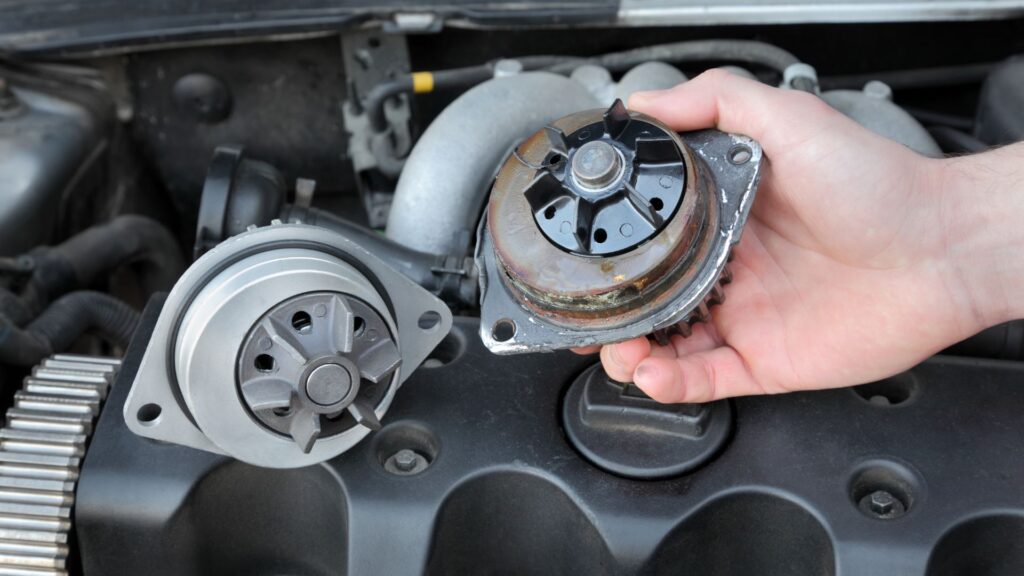
Sometimes the signs aren’t sounds or smells but visual. A physical inspection of the pump can reveal pitting, rust, or crusty mineral buildup around the housing. These are signs that coolant has been seeping past the seals gradually, even when you haven’t noticed a visible leak.
This kind of wear often signals that the pump is close to the end of its usable life.
What Makes Water Pumps Wear Out?
Age and mileage are the biggest factors. Most pumps last somewhere between 60,000 and 100,000 miles, though that range varies depending on the vehicle and how well the cooling system has been maintained.
Using the wrong type of coolant, neglecting flushes, or running low on fluid all accelerate wear and tear significantly. In some vehicles, the water pump is driven by the timing belt. When the timing belt is due for replacement, it often makes sense to replace the pump at the same time since the labor overlaps and skipping it can cost you more down the road.
Why Acting Fast Actually Saves You Money
A water pump replacement is not a cheap repair, but it’s far less expensive than what comes next if you let it go. Engine damage from overheating can mean head gasket failure, cracked components, or a complete engine replacement.
Treating cooling system issues as minor inconveniences is one of the most common and costly mistakes vehicle owners make. The oil keeps parts lubricated, but the cooling system keeps everything from melting down. Both need to be in working order.
What to Do When You Notice Water Pump Failure Signs
If your car is showing any of these signs, take them seriously before the situation turns into an expensive lesson. At Newnum and Sons Garage in Covington, IN, the team specializes in radiator system diagnostics and repairs, including water pump replacement. They’ll tell you exactly what’s going on before any work begins, with no surprises on the bill. Call 765-793-3334 to schedule a cooling system inspection and keep your engine running the way it should.